
Our Second Workaway: Blagaj
A week in (Bosnia and) Herzegovina


After a relaxing week in Sarajevo, we arranged another workaway in a town called Blagaj (a short drive from Mostar, Bosnia and Herzegovina’s 5th largest city). This workaway couldn't have been more different than our first experience in Biokovina: we were the only workawayers, the location was much less remote, and our hosts were more directly involved and closer to our age. Working hours were less structured, so we usually ended up helping out for three or four hours in the morning and leaving our afternoons free. This week we were mostly helping out in the garden, so it was convenient that we had mostly pleasant weather.
This week will be our fourth and final week in Bosnia. If you'd asked us about our plans a few months ago, we would have said we planned to visit the country, but neither of us would have predicted spending a month here. We're very glad we took our time - Bosnia and Herzegovina is a beautiful country filled with kind, friendly people and a rich and fascinating history. This week has been a great example of our experience in the country, we arrived without much of an idea what we wanted to see and with a bit of nervousness that comes from setting off to a new workaway. The week flew by with plenty of sights to see, we were warmly welcomed, and by the time we left we were staying with friends rather than workaway hosts.
16-Apr-2025: Arriving in Blagaj
We decided to take the train from Sarajevo to Mostar as it was both cheaper and faster than the bus. Trains also tend to be more comfortable than busses, so it seemed like a win-win-win decision. However, getting our hands on tickets seemed to be a bit more complicated than necessary. We tried to buy in advance, but were told it is only possible to buy tickets on the day of departure. The morning train left Sarajevo at 7:15am, so we had an early morning and arrived at the station around 6:30am. With only one ticket window open, the queue was slow. Luckily we beat the rush and there weren't many people in front of us; we didn't stick around, but it looked like the people at the end of the queue might have struggled to buy a ticket in time to catch the train. In the end we managed to procure an old-fashioned looking ticket and make our way to the train with plenty of time to spare - off to Mostar! Interestingly, it seemed like quite a few locals just got straight onto the train and bought tickets from the inspector after departing; this would be a much less stressful method, but it wasn't quite clear if you're supposed to do this and we wouldn't want to risk getting a fine (especially since we don't speak Bosnian…).

The journey to Mostar was stunning with steep mountains, blue rivers, and villages dotting the countryside. We appreciated the sight of new green leaves on the trees - spring has sprung in Herzegovina!
Megan and Faris met us at the train station and drove us to their place. On our drive into Blagaj, we drove along main road in Mostar. This is the dividing line between the Croatian (Catholic) and Bosniak (Muslim) parts of the city. Faris and Megan had pointed out the school which was notable for being a “mixed school”, however Croatian and Bosniak students learn on separate floors. Megan also told us of an encounter at a pharmacy, where a she had said that she can speak some Bosnian. The woman behind the counter replied that they speak Croatian here (despite the two languages being effectively the same). These are examples that illustrate how the country continues to be divided. Faris says that a lot of those attitudes are held by the older generation. He says that he and his friends don't care what ethnic group people belong to. The younger generation is more able to get a along and work together. Prior to the Bosnian war, the various communities lived side by side. Faris told us a story about his grandmother from the war years; she was living on the Croatian side of the city and a Croatian neighbor warned her that hostile Croatians were planning to come door to door and suggested either heading to the Bosniak side of town for a while or giving a Croatian name if strangers came knocking. Hopefully the accepting attitude of the younger generation is a sign of the slow healing of divisions and scars remaining from the conflict here.
Faris expressed annoyance with the structure of the government (with 3 different presidents of each ethnicity), saying that we are all Bosnians and we should have one president together. Interestingly, this is a similar view to one that Fadil shared in Biokovina. We've spent most of our time in the generally Muslim majority Federation of Bosnia and Herzegovina; it would be interesting to know whether or not this opinion is widely held across the country.
After arriving in Blagaj, we had Bosnian coffee and chatted for a couple hours. Megan is from Ireland and met Faris a few years ago when she was travelling the Balkans. They are living in Faris’s riverside family home in the historic town of Blagaj which has a monastery that attracts bus loads of tourists (typically coming up from the nearby Dubrovnik). Faris’s family have now all left to live in the nearby city of Mostar, and the young couple is living in the house which is split into a one bedroom apartment on the first floor and a studio on the ground floor. They hope to get some work done on the studio and garden and eventually put the studio on Airbnb. For this reason as well as to make connections and share culture, they decided to try workaway. We were lucky enough to be their first workaway guests! They have two dogs and two cats; all four are very friendly. Mickey, a belgian malinois, is absolutely obsessed with fetching anything (even small pieces of garbage or foam). He is so persistent that it is difficult to get much done as he insists for his toys to be thrown (often he’d come and put a toy in a wheelbarrow we were filling with soil, for example). Faris even told us to put toys in trees, just slightly out of Mickey’s reach so that he could be distracted and tire himself out for a while jumping under the tree - which is also quite entertaining to watch.


Eventually, we got to work for the day. Our first set of tasks were moving wood, roof tiles, and bricks into a storage area under the house. We also cleaned and rearranged some garden furniture, cleaned their beautiful riverside porch area, and cleaned the BBQ.
In the evening, we joined Megan and Faris for a gorgeous dinner and lovely chats. Megan made Bosnian peksimeti as an appetizer, which are fried dough balls. We ate them with ajvar, kaymak (soft delicious white cheese), and smoked meat; they probably would be delicious with any savory sauce or even as a dessert with something sweet. We also had chicken, fish, salad and roast veg - the original plan was to BBQ, but the weather turned stormy in the evening.


We chatted for a long time about many things. Faris' shared some stories from his dad, grandparents and uncles. Faris is our age, and born after the war, but grew up with all the history and after effects of the war in his life. Faris previously worked in the military, and has quite a few friends who work in close protection abroad in places like Baghdad, Mali etc. Faris and Megan were both quite curious about Mary’s experience working in Chad with MSF. Mary shared her experience of MSF, security, risk management, using the radios, contingency plans, and how MSF works with unarmed guards.
17-Apr-2025: Work and a Wander to the Tekija
Our task for this morning was power washing a patio outside our door and and filling flower beds with dirt from the other side of the yard. Mary worked on the patio while Scott shoveled the dirt.


After we'd finished working for the day, we wandered into the main part of Blagaj to investigate the area. The main attraction in town is the Blagaj Tekija, an old Sufi Monastery right by the source of the Buna river. This seems to be a staple on the tourist trail here as there seemed to be plenty of room for parking, we saw a couple of coaches, and the road to the Tekija is lined with kiosks selling various souvenirs. Archeological excavations show that the site was in use before the arrival of the Ottomans, but the earliest surviving written records date to 1664 where it is described as a well-known site across the Ottoman Empire. We crossed the river to enjoy the view before heading back to Faris and Megan's.


In the evening we went on an impromptu trip into town; Faris's dad was driving Megan to Mostar, so we hitched a ride. We wandered through the beautiful “Old Town” of Mostar for the first time in twilight and then in the dark. Megan told us that Mostar has surprisingly good ice cream for a tourist town in Bosnia; explaining that a lot of people fled to other countries such as Italy when the war began. Some of them eventually returned and brought gelato back with them. We suspect that a constant stream of tourists in recent years and very hot summers (we were told it can get well into the 40s in Mostar) also help to drive demand. It was a mild evening and we decided to enjoy ice cream and then some craft beer before joining up with Megan and Faris at the restaurant where Faris works. We had some rakija and tried to stay out of the way while they were closing up before heading back to Blagaj.


19-Apr-2025: The Unofficial Route to Herceg Stjepan's Fortress
We had the weekend “off” in terms of work. Overall, it was a fairly relaxing day (at least for Mary). In the morning Mary played around with sourdough while Scott investigated a hiking trail his map described as an “Expert or Indiscernible Trail”. The first bit was steep and not the most well travelled, but marked and not too difficult. The fork off towards “The Green Cave” was extremely steep (climbing 160m in elevation in only 210m of distance) and required a bit of scrambling. It soon became obvious that reaching the cave and returning would not be possible in the “about an hour” time estimate Scott had given before departing, so the climb as aborted about half way through the difficult section.
We relaxed with Megan while Faris was at work. In the afternoon, we went on a hike continuing along the easier trail then setting off into the unknown to make a circular route to Herceg Stjepan's Fortress - a hilltop castle overlooking Blagaj. The easy trail ended shortly past some rock climbing routes; from here, it really was an indiscernible trail through a pretty steep and rocky area. Only some minor scrambling was required and we were rewarded with fantastic views from a peak labeled “Orlovača” on Scott's map: a view over some interesting rock formations on the next mountain, the ruins of what Google suggests is a Roman watchtower, Herceg Stjepan's Fortress which was now below us, and the valley stretching away from Blagaj.


A much easier climb down brought us to Herceg Stjepan's Fortress which has been partially restored. Unfortunately there isn't any information available about the castle on site, but it is free to visit. Faris had mentioned the castle predates the town of Blagaj and is sometimes called the old town of Blagaj. A gentle switchback trail took us back to a road from which it was a short walk back into Blagaj. Despite being short, our hike was fairly steep and tiring - we spent the rest of the evening relaxing.


20-Apr-2025: Mostar Walking Tour
We caught a ride into Mostar with Faris and arrived just in time for a free walking tour. Faris thought the tour started at 9:30am (we're pretty sure this was the same company he did tours with when he and Megan met) and the start point was right next to the restaurant where he works. We were a few minutes late and hadn’t signed up for the tour, but fortunately it wasn’t too busy in shoulder season and a couple of people who did book were also running late so we could join the tour.
Our tour guide was warm and welcoming, and clearly loves her job. She started with a bit of a geography lesson outside the old tannery, and an appeal for us (and people in general) to stop referring to Bosnia and Herzegovina as just “Bosnia”. If “Bosnia and Herzegovina” was too long, she suggested “B and H” which is the abbreviated name used on license plates. The name of the country refers to two distinct geographical regions. Bosnia being the section to the north and Herzegovina, where Mostar is located, in the sunnier south.
At our next stop, our guide explained that Mostar is named for its bridges; “most” means bridge in Bosnian. The most famous bridge in Mostar is “Stari Most” (which translates to “Old Bridge”). The old bridge was built by the Ottomans and spans the Neretvica river some 20-25m below. The river is a striking blue-green colour providing a stark contrast with the arid rocky surroundings. Our guide informed us that the colour is due to copper content of the rocks in the area; she also mentioned that the water is very cold, below 10 C even on the hottest summer day. Stari Most initially served to connect the sides of the city, but soon was used by “local crazy men” to jump into the river with the goal of impressing local women and gathering money from passersby. Today, locals in the Mostar diving club regularly jump after collecting around €50. Tourists can also jump if they first complete a training course with the club and each summer Redbull comes to Mostar for an extreme sports event where they erect a 10m diving platform on top of Stari Most.


Our guide also spoke a lot about the war. She is a Bosniak who was born in Mostar and was 14 when the war started. Being a teenager at the time, she remembers both the economic issues and hyperinflation preceding the dissolution of Yugoslavia and the horrors of the war. Our guide explained that due to economic collapse Yugoslavia had become fertile land for nationalism and manipulation. Religion and ethnicity were misused to divide people. Being in the middle of Yugoslavia and with ethnic groups mixed throughout the country, Bosnia and Herzegovina became the centre of this division in the conflict that followed.
Mostar saw shifting alliances and some of the worst destruction in the country during the war. Initially the Bosnian and Croat armies allied against the Bosnian Serb/Yugoslav army which was attacking from the East. Later, the Croatians and Serbs struck a deal to split Bosnia and Herzegovina and the Croats turned on the Bosnian army, attacking the city from the West. As a result, 60-75% of the Bosniak parts of the city were destroyed - including most of the old town and the the old bridge.
From 1998-2004, the historic center of Mostar was meticulously restored by UNESCO. Our guide described it as one of the newest old towns in the world as pretty much everything was built after the war despite its 16th century Ottoman appearance.


To end our tour, we visited a couple of places outside of the restored old town. First was Karadoz Beg mosque. As the mosque is outside the official UNESCO world heritage site, it did not receive international funds for reconstruction. Reconstruction was funded by the community, resulting in reuse of materials where possible. To this day, the side of the mosque has the visible evidence of the war: bullet holes and scars from shrapnel.


Our final stop was a wartime cemetery. During the war, it was too dangerous to bury people in existing cemeteries outside of town. As a result, parks in the city were turned into cemeteries. Here rows of headstones serve as a reminder of the war with nearly all death dates being in 1993.

Sadly an estimated 100 000 people died during the war in Bosnia and there was an overall lack of international pressure due to fear of Russia (which generally supports Serbia). Our tour guide expressed a desire to talk openly and often about the war, not because she likes to revisit the pain, but because she wants to do her part so that people remember what happened so as not the repeat history.
After our interesting, but sad tour we wandered down in the bright sunshine to watch people jump off the bridge as well as the practice structure. We then continued wandering around the old town and had coffee and then lunch at Faris’s restaurant.
When Faris’s shift ended we headed back to Blagaj. We relaxed at the riverside and at dusk Megan and Faris took us on an adventure to visit the nearby source of the spring.


21-Apr-2025: Faris's Birthday
Today Scott power washed the path and the riverside patio; some combination of the size of the area, quite a bit of grime, and the strength of the power washer made this a slow process. Meanwhile, Mary weeded and overturned the soil at the base of the trees in the garden.


Today was Faris’s 28th birthday! After we finished helping out around the garden for the day, Megan made burgers for an early dinner. Mary gave Megan some of the sourdough starter to get her a starter going (both Mary and Megan became very excited about the sourdough).


Around 6 pm we headed out to Mostar. Faris had an appointment for a haircut, so while he did that Megan took us on a little tour of parts of Mostar away from the old town. The highlight was a slightly strange residential neighborhood which was bordered by the prison. The prison wall and the ends of residential buildings were covered by street art; part of on installation suggested this is part of a regular street art festival in Mostar. Another peculiarity of the neighborhood (the first being a prison right in the middle of a residential neighborhood) was the bullet hole riddled shells of buildings interspersed between those that had been repaired or reconstructed. Almost three decades after the end of the war, the scars of war are very much still visible away from the touristy centre of the city.


After Faris rejoined us, we went to a mall and had a drink at the bar. We played some pool and a bunch of arcade games before Faris decided he wanted to go go karting. He booked a slot at 10 pm and we went for a race. Mary was impressively slow - so much so that the staff at the track had to try and tell her not to be so scared. A little adrenaline rush was a fun way to end the evening. 🏎️
23-Apr-2025: Doviđenja Bosnia
Today we got up early and went into town with Megan and Faris who had work and an appointment. We sat around and had coffee together, then went our separate ways. We did a final wander of the old town and had some borek from the bakery recommended by our tour guide. Mary also went into the copper shop that our tour guide had recommended and bought a beautiful handmade ring for 10 euros after spending a long time being indecisive about the options. This copper shop is run by an older couple. They are an interfaith couple: Muslim and Catholic. The man showed us the beautiful plates he makes of Mostar for tourists, with the old bridge connecting the Croatian and Muslim communities, with a church on the left side and a mosque on the right side of the bridge. The plate is also decorated with symbols such as doves for peace, and a pomegranate symbolizing abundance and prosperity. He does this art to show people that peace is valuable and important. His wife and daughters make the jewelry, and he and his son make the plates and Bosnian coffee sets.


After our return to Blagaj to gather our things, it was time to catch our 4 pm bus to Montenegro. More on that in our next installment!
Some Stuff About Food
We didn't cook anything particularly Bosnian this week, but did sample some Bosnian food that Megan cooked and at Faris's restaurant. One notable meal we cooked was a repeat of the “Spaghetti alla Puttanesca” from our time in Campania. This time we made our “rustic handmade pasta” in two varieties: one standard and one “low gluten” batch using mostly buckwheat flour (and a bit of normal flour to help with the texture) to try and accommodate our hosts dietary preferences. Although the texture was a bit strange from the relatively coarse buckwheat flour, the low gluten batch turned out reasonably well. Although we've left Italy, where trying to maintain our pasta making skills when a good opportunity arises!

Travel Stats
As we were at a Workaway, we didn't travel particularly far. The train journey from Sarajevo to Mostar covered only 129km and the short drive between Blagaj and Mostar was something like 14 km each way.
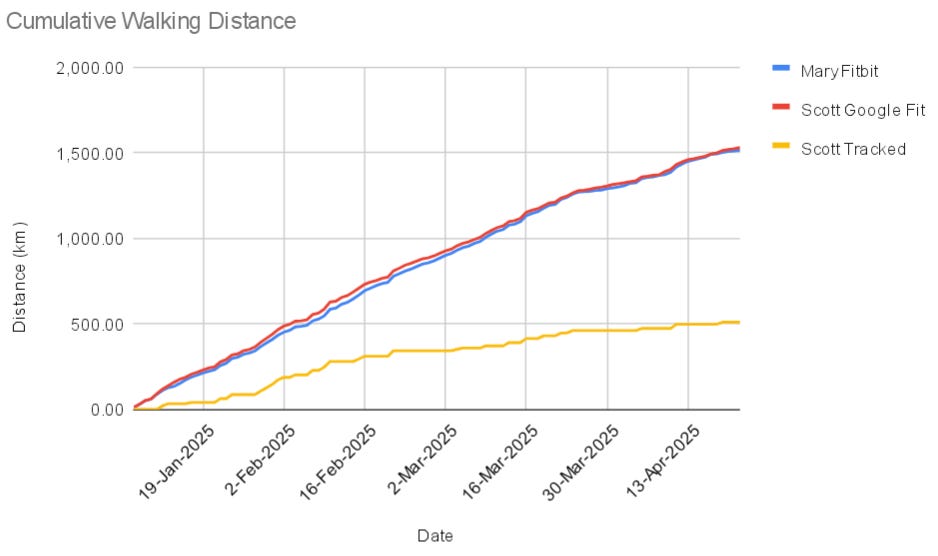
This week we also walked an uncharacteristically short distance. We only walked about 49.2km or just over 7 km/day. This takes our 106 day total to 1517.4km.
To Be Continued…
We can't say enough good things about Bosnia and Herzegovina and we'd highly recommend visiting if you haven't been. In some ways it's sad to to be leaving, but the time has come to make our way into Montenegro. Tune in to our next update to see what the 15th country we visit brings our way!